
TL;DR
- A battle card is only useful in the seconds after a competitor is named, which rules out anything requiring a search.
- Write for the rep who has not memorised the category. A card assuming familiarity gets skipped mid-call.
- One genuine, current, verifiable difference beats a feature matrix, because the buyer can check it while you are still talking.
- Cards decay. Citing a competitor limitation they fixed last quarter damages the deal the card was written to win.
The buyer names a competitor. The rep remembers that someone created a comparison document, searches the shared drive, opens an old deck and starts reading while the customer keeps talking.
The information exists. It is still difficult to use at the moment it matters.
A battle card should reduce that work. It needs enough substance to help the rep answer accurately, and enough restraint to fit the conversation. A long list of advantages is rarely the most useful format.
Build each card around a specific buying situation. What is the customer trying to accomplish? What distinction affects that outcome? What can we prove? What question will help us understand the requirement?
Start with a real buying situation
A company can be a competitor in one workflow and a reasonable companion in another. A product may be strong for manager review while another is useful for the seller during a call.
The card should state the situation it covers. "Enterprise call-review replacement" and "individual rep needs live product answers" are different comparisons. Mixing them produces broad claims that become difficult to defend.
For example, Gong documents substantial coaching workflows involving recorded calls, feedback and scorecards. A card comparing an individual live assistant with Gong should acknowledge those jobs before discussing the rep's in-call needs. 1
Use the buyer's requirements to determine the comparison. Do not choose a narrow row simply because your product wins it while ignoring a capability the buyer considers mandatory.
What belongs on the card
A situation label
Give the rep enough context to recognize whether the card applies. Include the relevant use case and, where necessary, plan, platform or mode.
A genuine competitor strength
This establishes a fair starting point and prevents a rep from dismissing something the buyer already values. It also helps the rep understand why the alternative is in the evaluation.
The specific difference
Describe the behavior, not a vague adjective. "Requires this capture mode for this feature" is useful. "Less modern" is not.
A clarifying question
Ask about the requirement that makes the difference relevant. Avoid forcing the buyer into a scripted agreement. The answer may reveal that the difference does not matter to them.
Evidence and limits
Link to current official documentation, an approved demonstration or a customer reference you have permission to use. State the limitation that keeps the answer accurate.
Ownership
Name the person responsible for maintaining the card and include a review date. A stale comparison can turn an otherwise capable rep into a source of misinformation.
A current example of a meaningful difference
As of September 10, 2026, Fireflies documents bot-free desktop Live Assist, while its automatic knowledge-base Sales Assist requires a bot meeting. That is a specific mode distinction. Saying Fireflies has no bot-free AI would be inaccurate. 2
A useful card would ask whether the buyer needs automatic company-knowledge assistance in the same bot-free workflow they intend to use for capture. If they do, the mode restriction is relevant. If they only need notes and on-demand help, it may not be decisive.
The follow-up should be a demonstration of the requested workflow, including setup and limitations. It should not be a claim that one product is better at everything.
The same discipline applies to Fathom. Its current documentation includes bot-free capture options, with platform and rollout conditions. An old card stating that it always adds a bot should be retired. 3
A copyable battle-card format
The following is an original template for your approved content. Replace the fields with verified information before using it in a customer conversation.
CARD TITLE
Competitor + specific buying situation

WHEN TO USE
The requirement or question that makes this comparison relevant.

COMPETITOR STRENGTH
What they do well for this use case.

OUR RELEVANT DIFFERENCE
One or two specific behaviors, with scope and limitations.

ASK
One question that clarifies whether the difference matters.

PROVE
Current official source or approved demonstration.
Include the product mode, plan or version where relevant.

DO NOT CLAIM
Unsupported assertions, roadmap items or outdated comparisons.

NEXT STEP
The smallest useful validation for the buyer.

OWNER
Named content owner.

LAST REVIEWED
Date the important facts were checked.
Keep the first screen focused on what the rep needs immediately. Supporting detail can remain in the linked resource. Do not remove a qualification simply to make the card shorter; rewrite the claim so the qualification fits naturally.
Write for the rep who has not memorized the category
An experienced product marketer may understand why a feature distinction matters. A new rep may only see two similar labels.
Explain the consequence in plain terms. If a workflow requires a separate bot, the practical implication may be a host-admission step or a customer policy review. If a note format requires a manual request, the implication may be another action after each call. If a feature is coming soon, it cannot satisfy a present must-have requirement.
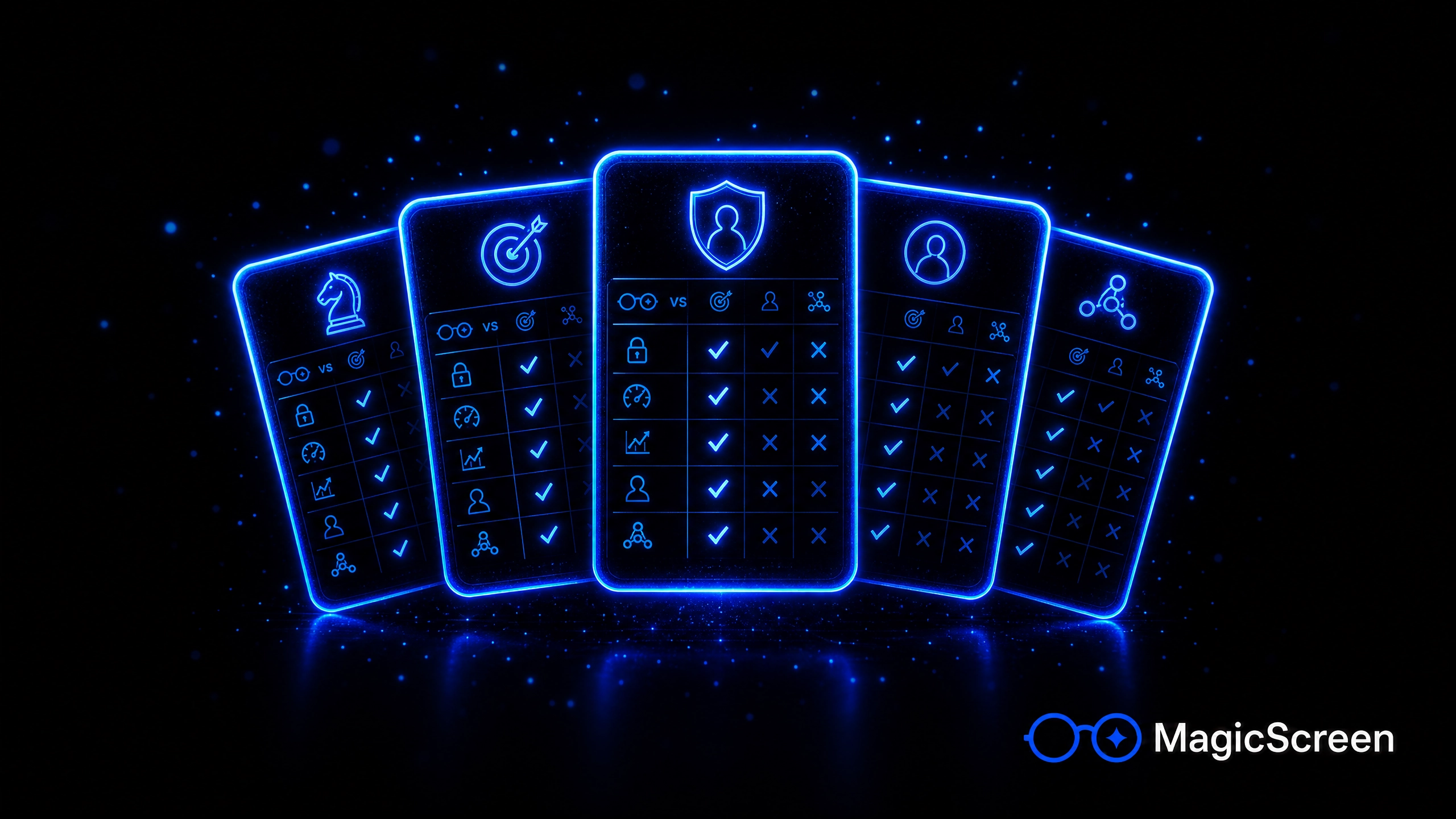
Avoid making the rep interpret an unexplained table of checkmarks. A checked box can hide a plan restriction, a partial integration or a feature available only in a mode the team will not use.
The card should help the rep describe the requirement accurately even when the right answer is that the competitor fits it well.
Put the resource where it can be used
Magic Screen's Resource Hub supports uploaded knowledge resources and distinguishes Insights from Scripts. Insights provide reference knowledge; Scripts are parsed into sections for a structured live conversation. 4 5
For a competitor reference, start with a concise, approved Insight. For a deliberate evaluation call, a Script can organize the questions and evidence the rep plans to cover. Magic Screen's live script controls allow the seller to move through or skip sections rather than follow a fixed sequence blindly. 6
Contextual live intelligence is designed to surface useful material around the conversation. Treat that as a delivery capability to validate. The presence of a competitor name alone does not prove the matching card is appropriate. 7
Initial resource preparation takes work. The repeatable benefit is that a seller can access the approved material inside the meeting workflow instead of repeatedly finding the document elsewhere.
Test the card before the team depends on it
Use fictional or approved practice conversations. Include the straightforward case, then test the boundaries.
Mention the competitor as an existing vendor. Mention it as a partner. Ask about an unrelated product from the same company. Discuss a requirement the card does not cover. Use an old feature name that a buyer may still recognize.
Inspect what the rep sees and what they do next. Does the card answer the question? Is its source accessible? Does it encourage a claim broader than the evidence? Can the rep read the important part without losing the buyer's next sentence?
Do not judge the resource only by whether it appeared. A visible but irrelevant card consumes attention. A correct card that requires too much reading may still need editing.
Keep a simple review log with the scenario, resource version, useful result, correction and next change. These observations improve the content without pretending that a small practice session proves a revenue lift.
Build a maintenance process before a large library
Assign each competitive area to someone who follows the relevant product. Review changeable facts before important campaigns and whenever a rep reports that a claim is outdated.
Pricing, plan allowances, supported platforms and integrations deserve particular attention. A source checked months ago should not be treated as a current quote. A roadmap item should not remain in a comparison after its status changes.
Maintain one authoritative version of the card. Archive or clearly retire older copies so a rep cannot accidentally retrieve a superseded claim. Where several teams reuse the content, make the update path visible.
Also review your own product claims. A competitor card should not be stricter about the other vendor's evidence than it is about yours. The same standard applies to speed, accuracy, privacy and integration promises.
Capture what the buyer actually cared about
After the meeting, record the criterion the buyer considered important. "Competitor discussed" is a weak account update. "Buyer requires automatic product guidance without adding a meeting participant" is a useful requirement.
Keep the final requirement in the account's working brief and preserve unresolved validation work as an action item. This connects the battle card to the sale instead of treating it as a detached marketing asset.
A good library grows from those conversations. Repeated questions can justify a new card; isolated wording changes do not require another nearly identical document.
Start with one competitive situation your team sees often. Build the card, verify the facts and add the resource to Magic Screen. Then test whether it helps the rep give a better-supported answer with less searching. That is a concrete standard the team can use.
Frequently asked questions
What should a sales battle card contain?
One genuine, current and verifiable difference, written for someone who has not memorised the category. A feature matrix cannot be read in the seconds after a competitor is named.
How often should battle cards be updated?
Whenever the competitor ships. A card citing a limitation they fixed last quarter actively damages the deal it was written to win.
Where should battle cards live?
Wherever the rep already is during the call. A card requiring a search is a card that will not be opened.
Sources
- Gong. Introduction to coaching. Checked September 10, 2026.
- Fireflies. Live Assist / Sales Assist desktop guide. Checked September 10, 2026.
- Fathom. Fathom 3.0. Checked September 10, 2026.
- Magic Screen. Building Your Knowledge Base. Checked September 10, 2026.
- Magic Screen. Uploading Sales Scripts. Checked September 10, 2026.
- Magic Screen. Sales Script Suggestions. Checked September 10, 2026.
- Magic Screen. Live Intelligence. Checked September 10, 2026.