
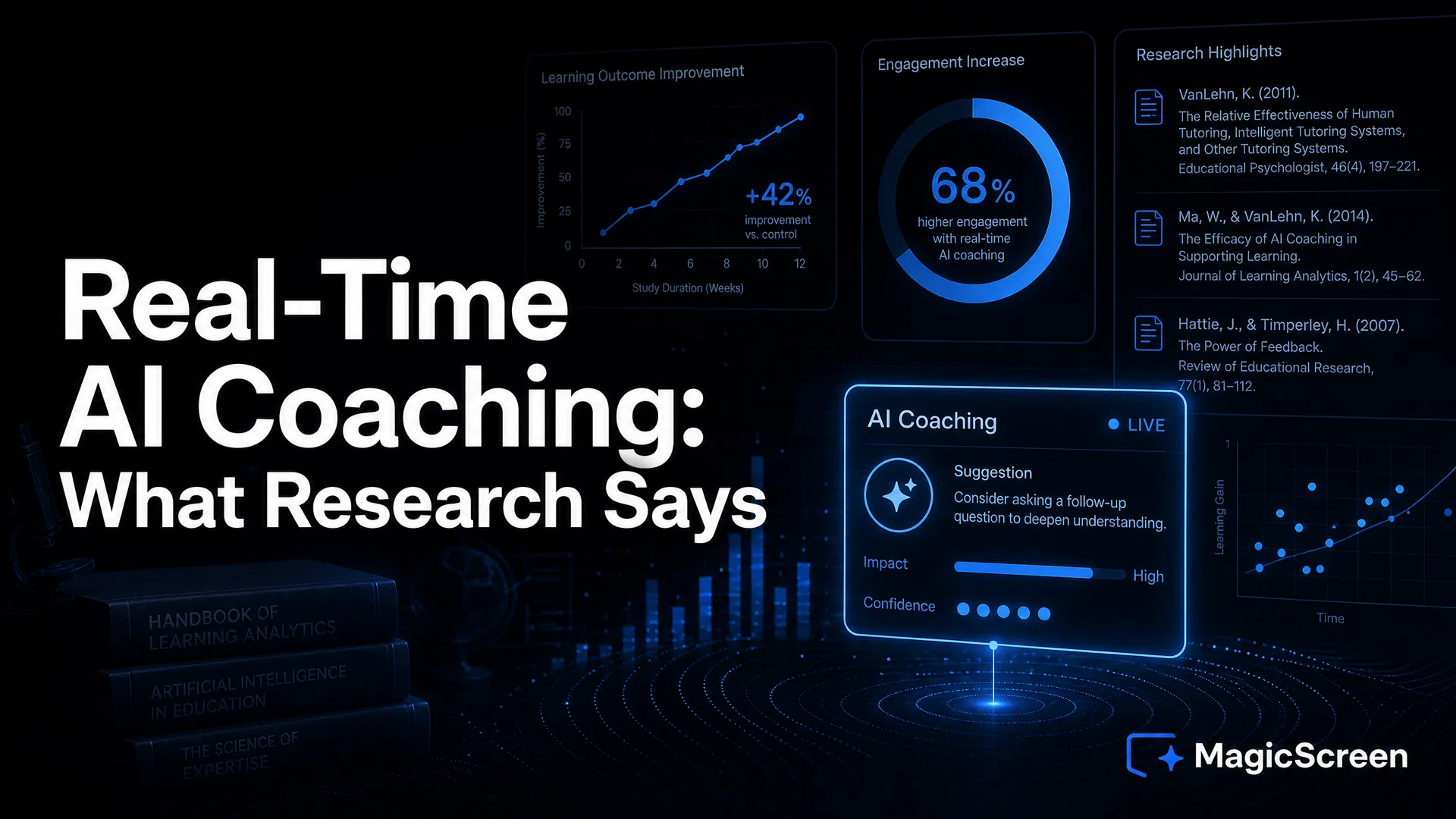
We started this review asking a simple question: does real-time sales coaching work? To answer that, we looked across the emerging literature — including Salesforce AI Research’s SalesCopilot paper, the commonly cited finding that reps spend roughly ~25% of their time on core selling activities, and research on the sales-training forgetting curve — and synthesized what the evidence and theory together imply for sales teams considering real-time AI coaching.
does real-time sales coaching work? Evidence from SalesCopilot and sales coaching research
The short answer is: research so far is promising but still early-stage. Salesforce AI Research’s SalesCopilot paper evaluates AI copilots in sales workflows and reports improvements in task completion, response relevance, and reduced time-to-draft for sellers using AI assistance. That aligns with a broader body of sales coaching research that associates timely, contextual coaching with better seller performance.
Key patterns across the literature:
- Contextuality matters: Studies and practice reports emphasize that feedback delivered in the moment, tied to the actual conversation or task, is more actionable than generic “classroom” training.
- Immediate feedback shortens iteration cycles: SalesCopilot and related work show AI can surface phrasing, objection responses, and product facts during the interaction, letting reps test and correct in real time.
- Measurement improves: AI overlays and copilots capture interaction signals (keywords, objection types, response timing) that make coaching outcomes more measurable and automatable.
That group of findings is consistent with decades of learning science and more recent applied research in sales: when coaching is frequent, contextual, and measurable, seller behavior changes faster. The caveat is that many studies — including SalesCopilot — are early evaluations in controlled or pilot environments, so broader generalizability still needs more field replication.
Why does real-time sales coaching work? Selling-time constraints and the forgetting curve
Two operational facts help explain why real-time coaching has been effective in pilots and early deployments.
- Limited selling time. Multiple industry studies observe that sales reps spend a minority of their workweek on direct selling activities; a commonly referenced figure is that reps spend roughly ~25% of their time on core selling. That means any approach that increases the proportion of time spent in value-creating selling activities — or improves the quality of those interactions — can have outsized impact.
- The sales-training forgetting curve. Learning science — beginning with Ebbinghaus and replicated across contexts — shows learners lose a large share of newly taught material unless it is reinforced. Applied work on sales training consistently reports rapid decay in recall and application unless training is reinforced with coaching, role-play, or on-the-job prompts.
Combine those two points and the logic becomes straightforward: because you have limited real selling time, and because conventional training decays quickly, the most efficient place to affect behavior is during the selling moment itself. Real-time AI coaching addresses both constraints by delivering micro-feedback and reminders in context, thereby increasing the likelihood that the right behavior is used when it matters.
Mechanisms through which real-time coaching operates:
- Immediate corrective feedback (fix the wording, add a demo step)
- Microlearning: short, on-demand prompts instead of hour-long courses
- Reinforcement scheduling: repeated nudges that combat forgetting
- Data-driven personalization: the AI tailors suggestions to the rep’s skill gaps
How research frames ai coaching effectiveness and common limitations
When we review ai coaching effectiveness in the literature, a few recurring themes and limits appear:
- Effect size varies by use case. AI helps most where factual recall, phrasing, object identification, or compliance are critical. Complex consultative selling that relies on deep human judgment may benefit less from canned prompts.
- Design and integration matter. The studies that report positive results tend to use AI integrated into the rep’s workflow (overlay or co-pilot) rather than a separate tool reps must switch to.
- Behavioral adoption is the bottleneck. Even accurate AI suggestions are only valuable if reps notice and accept them. Research suggests combining AI prompts with manager reinforcement yields better adoption.
- Privacy and trust trade-offs. Some teams worry about recording or surveillance. Real-time overlays that do not join or record calls (but still provide coaching) may reduce resistance — a point SalesCopilot-type solutions highlight in implementation notes.
Estimating real-time coaching ROI: a practical framework
Research papers rarely spell out ROI the way finance teams want, so we use a transparent framework that you can apply to your numbers. The key inputs are:
- Baseline selling time per rep (use the ~25% figure as a starting benchmark if you lack internal data)
- Baseline conversion or average deal value
- Expected relative improvement from real-time coaching (from pilots or vendor literature)
- Cost of the coaching solution (software + adoption training)
- Ramp and retention effects (time-to-quota reductions, churn reductions)
Illustrative, hypothetical calculation (for clarity, not a claim):
- Assume a rep spends 25% of a 40-hour week selling = 10 hours of selling time.
- If real-time coaching increases selling efficiency by 10% (so those 10 hours become 11 hours worth of effective selling), that’s a 1 hour/week equivalent gain.
- If that extra hour leads to proportional increases in closed-won revenue (or to a reduction in time-to-quota), multiply the incremental revenue by your per-rep margin and subtract cost to get ROI.
That kind of back-of-envelope shows why researchers and practitioners point to even small relative gains as economically meaningful when applied across many reps. Research on ai coaching effectiveness often frames impact in these relative-improvement terms rather than absolute dollars, which makes it easier to test in pilots.
Practical checklist for testing ROI in a pilot
- Measure baseline selling time, conversion rates, and ramp time before the pilot.
- Run the pilot with clear engagement metrics (prompt acceptance, suggestion edits, use rate).
- Track short-term performance (next-month conversion lift) and medium-term retention of behaviors (are prompts still used after 60–90 days?).
- Include a control group wherever possible to separate coaching effect from seasonal or territory effects.
Comparing approaches: traditional training vs. scheduled coaching vs. real-time AI coaching
| Dimension | Traditional Training (workshops) | Scheduled Coaching (weekly 1:1) | Real-Time AI Coaching (in-call overlay) |
|---|---|---|---|
| Timing | Pre-scheduled, asynchronous | Regular but not in-the-moment | Immediate, in-context |
| Personalization | Low to moderate | High (depends on coach bandwidth) | High and scalable |
| Retention impact | Prone to forgetting curve | Better if reinforced | Designed to combat forgetting via nudges |
| Scalability | Limited by instructors | Limited by manager time | High; software scales with users |
| Measurement | Post-hoc, coarse | Manager notes + recordings | Fine-grained, event-level metrics |
| Privacy considerations | Low | Depends on recording | Varies — overlay solutions can avoid recording |
does real-time sales coaching work? Our take and recommended next steps
Putting the literature together: real-time sales coaching is not a silver bullet, but research (including SalesCopilot’s results and broader sales coaching research) suggests it is a high-leverage intervention for many teams. It directly addresses two chronic problems: limited selling time (the ~25% selling-time constraint) and rapid decay from conventional training (the sales-training forgetting curve). Where it works best, you see faster skill application, measurable behavior change, and improved ramp efficiency.
If you’re evaluating real-time AI coaching, we recommend this pragmatic sequence:
- Run a time-and-motion baseline so you can measure the 25% selling-time assumption against your reality.
- Start with a small, well-instrumented pilot focusing on high-impact behaviors (objection handling, discovery questions, product value props).
- Measure both adoption (do reps accept suggestions?) and outcomes (conversion, time-to-close, demo-to-opportunity ratio).
- Combine AI prompts with manager reinforcement to improve adoption and address behavioral barriers.
Applied carefully, research suggests real-time coaching can produce measurable gains in ai coaching effectiveness and real-time coaching ROI. The remaining open questions are largely operational: how you implement, measure, and scale the approach across rep segments and product lines.
For teams that want to move from concept to test quickly, an overlay solution that provides context-aware prompts without joining or recording calls reduces adoption friction and preserves privacy — a practical design point that the research community has flagged as important for real-world deployments.
Ready to test real-time coaching? If you want a low-friction way to pilot real-time, in-call coaching that doesn’t join or record meetings, try MagicScreen. We built an invisible overlay that gives reps live coaching, objection handling, and auto-generated notes on Zoom, Google Meet, and Microsoft Teams. Download a free tier or start a Pro trial at /download.