
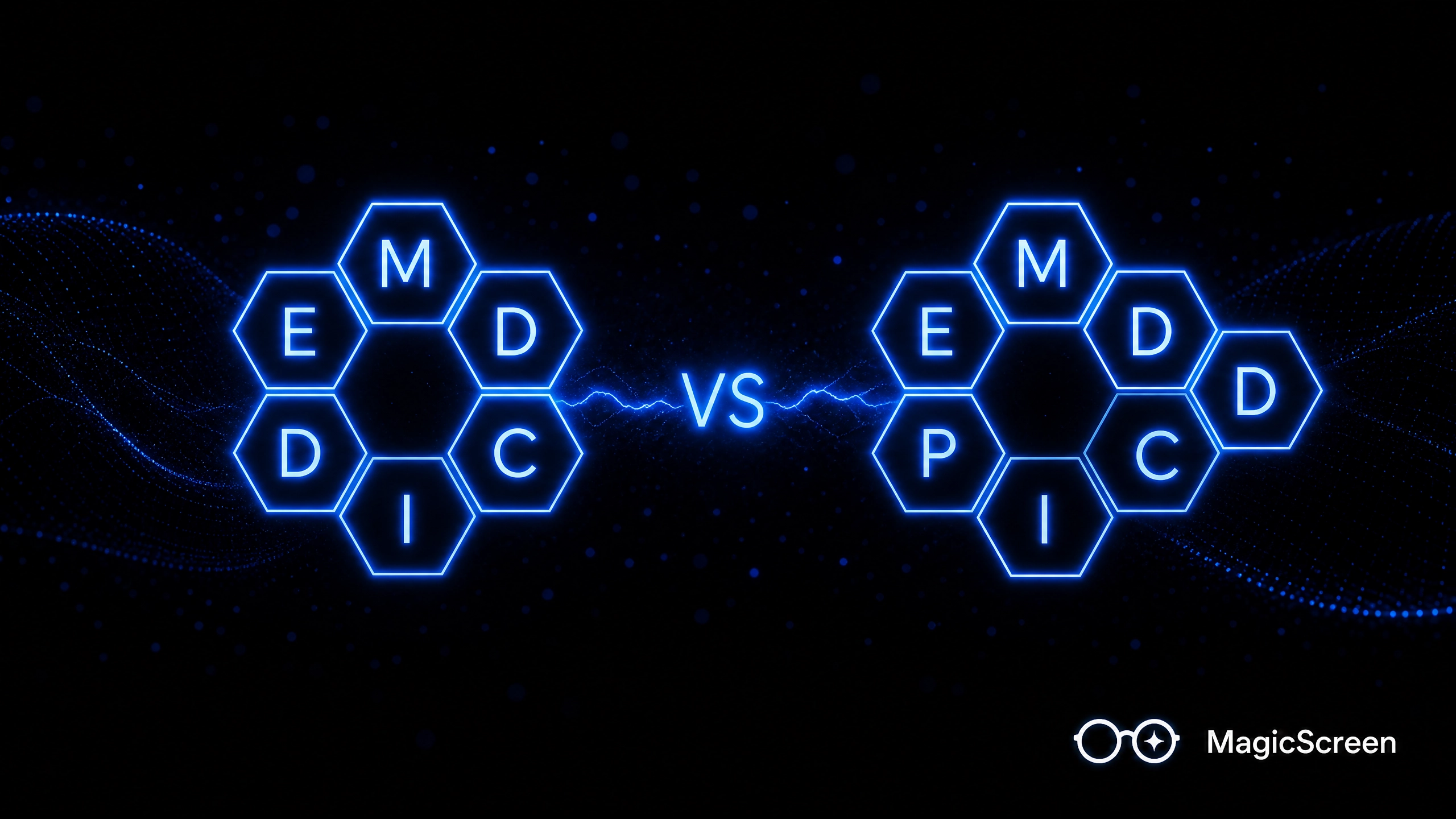
Sales qualification frameworks exist for one reason: to help revenue teams separate deals that will close from deals that won't. The cost of getting this wrong is enormous — not just in lost deals, but in the time, energy, and resources invested in pursuing opportunities that were never real. The right qualification framework, applied consistently, is one of the highest-leverage investments a revenue organization can make.
MEDDIC and MEDDPICC are the two most widely adopted qualification frameworks in enterprise B2B sales. They share a common foundation but differ in two important dimensions — and those differences matter significantly depending on the complexity of your deals and the size of your typical buying committee.
MEDDIC: The Foundation
MEDDIC was developed at PTC in the 1990s and has become the dominant qualification framework in enterprise software sales. The acronym stands for:
- M — Metrics: What is the quantified business impact of solving this problem? What does success look like in numbers?
- E — Economic Buyer: Who has the authority to approve the budget? Have you spoken to them directly?
- D — Decision Criteria: What criteria will the buying committee use to evaluate and select a solution?
- D — Decision Process: What are the steps, timeline, and stakeholders involved in making the decision?
- I — Identify Pain: What is the specific, quantified business problem that this purchase is solving?
- C — Champion: Who inside the customer organization is advocating for your solution and has the influence to drive the decision?
MEDDIC's power is in its insistence on specificity. A deal where you can't answer all six questions with specific, verified information is a deal that isn't qualified — regardless of how enthusiastic the prospect seems. The framework forces reps to do the work of understanding the customer's decision process rather than assuming it.
MEDDPICC: The Enterprise Extension
MEDDPICC adds two additional dimensions to the MEDDIC framework:
- P — Paper Process: What is the legal and procurement process required to execute the contract? Who is involved, and how long does it typically take?
- C — Competition: Who else is the customer evaluating? What is your competitive position, and what is the risk of losing to a specific competitor or to 'no decision'?
These additions are not cosmetic. For enterprise deals with complex procurement processes and multiple competing vendors, the Paper Process and Competition dimensions are often the difference between a deal that closes in Q4 and one that slips to Q1 — or never closes at all.
When to Use MEDDIC vs. MEDDPICC
The choice between MEDDIC and MEDDPICC is primarily a function of deal complexity. For mid-market deals with shorter sales cycles (under 90 days), simpler buying committees, and straightforward procurement processes, MEDDIC provides sufficient qualification rigor without the overhead of tracking two additional dimensions. For enterprise deals with longer cycles (90+ days), large buying committees, complex legal and procurement processes, and multiple competing vendors, MEDDPICC's additional dimensions are essential.
- Use MEDDIC when: Average deal size is under $50K, sales cycle is under 90 days, buying committee has fewer than 5 stakeholders, procurement process is straightforward
- Use MEDDPICC when: Average deal size is over $100K, sales cycle is 90+ days, buying committee has 5+ stakeholders, legal and procurement are significant factors, competitive landscape is complex
The Most Commonly Missed Dimensions
In practice, the dimensions that reps most often skip or underinvest in are the Economic Buyer and the Paper Process. The Economic Buyer is skipped because it requires getting access to a more senior stakeholder — which feels risky and uncomfortable. The Paper Process is skipped because it feels like a detail that can be sorted out later. Both of these omissions are expensive.
Deals where the rep has never spoken to the Economic Buyer are the most common source of late-stage surprises: the champion was enthusiastic, the demo went well, the proposal was accepted — and then the CFO killed it. Deals where the Paper Process was never mapped are the most common source of end-of-quarter slippage: the deal was 'ready to close' but the legal review takes six weeks and nobody knew.
Implementing the Framework Without Killing the Conversation
The most common failure mode in MEDDIC/MEDDPICC adoption is treating the framework as a checklist to complete rather than a guide for a conversation. Reps who interrogate prospects with a list of qualification questions — 'Who is your economic buyer? What are your decision criteria? What's your timeline?' — create a transactional dynamic that damages the relationship.
The framework should be invisible to the prospect. The questions that surface MEDDIC information should feel like natural discovery questions: 'What would need to be true for this to be a success for your team?' (Metrics), 'Who else needs to be involved in this decision?' (Economic Buyer, Decision Process), 'What are the most important things you're looking for in a solution?' (Decision Criteria). The framework is the structure behind the questions, not the questions themselves.
MEDDIC is not a script. It's a map. The rep who uses it as a script sounds like a robot. The rep who uses it as a map sounds like a trusted advisor.
Using AI to Track Qualification in Real Time
One of the most valuable applications of real-time AI in enterprise sales is MEDDIC/MEDDPICC tracking. MagicScreen can detect when a prospect provides information that maps to a qualification dimension — a mention of a budget cycle, a reference to the CFO's involvement, a statement about competing vendors — and flag it in real time, ensuring the rep captures the information and follows up on gaps. This turns qualification from a post-call exercise into a live, continuous process that improves data quality and deal accuracy simultaneously.