
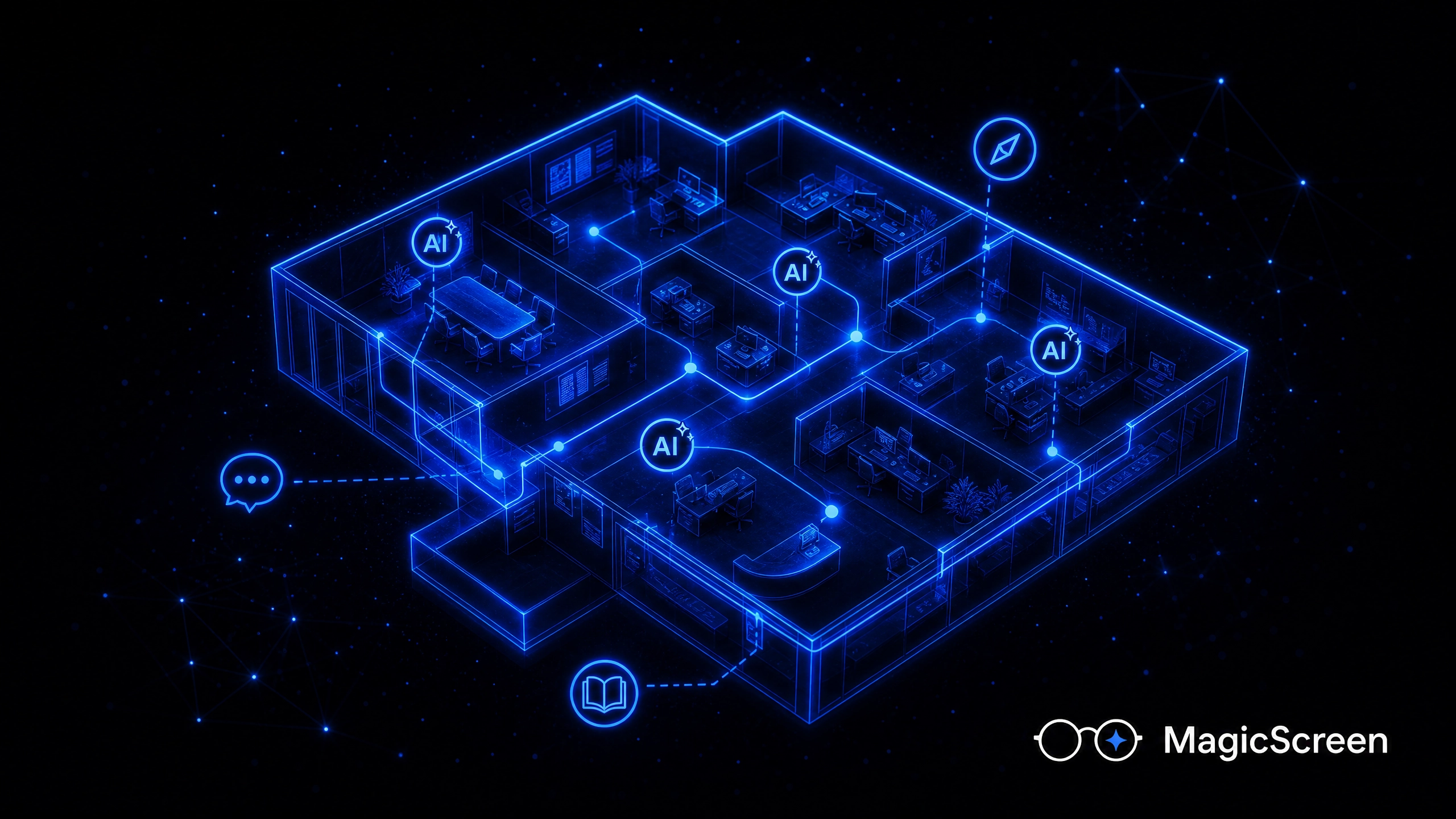
The sales floor of 2026 looks fundamentally different from the one of 2022. Not in the physical sense — most revenue teams are still distributed, still working from home offices and coffee shops and airport lounges. But in the cognitive sense: the tools available to a rep in a live conversation have changed more in the last three years than in the previous thirty. AI has moved from a back-office analytics tool to an active participant in the revenue process.
81% of sales organizations have deployed at least one AI tool as of 2026 — up from 24% in 2022 -- Salesforce State of Sales, 2026
This report synthesizes the most significant trends shaping AI adoption in sales in 2026: where the productivity gains are real, where the hype is outrunning the reality, and what the data says about which AI applications are actually moving revenue.
The Productivity Gains Are Real — But Unevenly Distributed
The headline number from Salesforce's 2026 State of Sales report is striking: AI-assisted reps report spending 28% more time on actual selling activities compared to non-AI-assisted reps. The time savings come primarily from three areas: call preparation (AI-generated account briefs and meeting agendas), post-call documentation (AI-generated call summaries and CRM updates), and research (AI-powered competitive and account intelligence).
28% more time spent on selling activities by AI-assisted reps vs. non-AI-assisted reps — equivalent to roughly 11 additional selling hours per week -- Salesforce State of Sales, 2026
But the gains are not evenly distributed. The reps who benefit most from AI tools are the ones who invest in learning to use them well — who treat AI as a skill to develop rather than a button to press. The reps who see minimal benefit are typically the ones who adopt tools superficially, using them for transcription but not for the higher-leverage applications like real-time coaching and competitive intelligence.
Real-Time AI: The Category That's Actually Moving Deals
The most significant development in sales AI in 2025–2026 is the emergence of real-time AI tools that operate during the conversation, not after it. This category — led by MagicScreen — represents a fundamentally different value proposition from post-call analytics platforms: instead of helping managers understand what happened, it helps reps change what's happening.
The business case for real-time AI is grounded in a simple insight from behavioral science: feedback is most effective when it's delivered at the moment of the behavior. A coaching prompt that appears during a live call — when the rep is about to respond to a price objection — is dramatically more effective than the same prompt delivered in a weekly 1:1 review. Real-time AI compresses the feedback loop from days to seconds.
35% improvement in objection handling success rate for reps using real-time AI coaching vs. post-call review only -- MagicScreen Internal Customer Data, 2025
AI Adoption by Function: Where the Impact Is Highest
Not all sales functions benefit equally from AI. The data from 2025–2026 shows the highest impact in three areas: outbound prospecting (AI-generated personalization at scale), in-call performance (real-time coaching and script delivery), and pipeline management (AI-powered deal health scoring and forecast accuracy).
- Outbound prospecting: AI tools that generate personalized outreach at scale have reduced the time required to research and write a cold email from 15 minutes to under 2 minutes, while improving response rates by an average of 23%.
- In-call performance: Real-time AI coaching tools have reduced the performance gap between top and bottom quartile reps by 40% in organizations that have deployed them at scale.
- Pipeline management: AI-powered deal health scoring has improved forecast accuracy by 31–43% across multiple enterprise deployments, reducing the end-of-quarter surprise factor that plagues most revenue organizations.
- Onboarding: AI-assisted onboarding programs have reduced average AE ramp time by 35% — from 3.2 months to under 2 months — in organizations with mature AI enablement stacks.
The Hype That Hasn't Delivered
Not every AI application in sales has delivered on its promise. The most overhyped category in 2025–2026 is AI-generated outreach at scale — the idea that AI can write thousands of personalized emails that feel genuinely personal. In practice, buyers have become increasingly adept at identifying AI-generated outreach, and response rates for AI-only outreach have declined as the volume of AI-generated messages has increased. The teams seeing the best results are using AI to accelerate human-written outreach, not to replace it.
AI-powered sales forecasting has also underdelivered in organizations that haven't invested in data quality. Garbage in, garbage out: AI forecast models are only as good as the CRM data they're trained on, and most CRMs are riddled with incomplete, inconsistent, or outdated data. The organizations that have seen the most benefit from AI forecasting are the ones that invested in CRM hygiene before deploying the AI layer.
The Rep Who Uses AI vs. The Rep Who Doesn't
2.3× higher quota attainment for reps who actively use AI coaching and enablement tools vs. those who don't -- CSO Insights, Sales Enablement Report, 2025
The performance gap between AI-assisted and non-AI-assisted reps is widening. In 2022, the gap was marginal — AI tools were too immature to deliver consistent value. In 2026, the gap is significant enough that it's showing up in quota attainment data, win rates, and ramp time comparisons. The rep who uses AI well is not just more efficient — they're more effective in the conversations that matter.
The implication for revenue leaders is clear: AI adoption is no longer a nice-to-have. It's a competitive requirement. The organizations that are deploying AI tools thoughtfully — with clear use cases, proper training, and measurement frameworks — are building a durable performance advantage over those that aren't.
What to Expect in the Next 12 Months
The trends that will define AI in sales through 2027: real-time AI will become the standard for high-performing sales teams (the bot-in-the-room model will continue to decline as privacy concerns grow), AI-generated deal coaching will move from experimental to mainstream, and the integration of AI tools with CRM systems will deepen to the point where manual CRM entry becomes largely obsolete. The sales floor of 2027 will look even more different from 2026 than 2026 looks from 2022.
The question for revenue leaders in 2026 is not whether to adopt AI. It's which AI applications to prioritize, how to measure their impact, and how to build the organizational capability to use them well.